
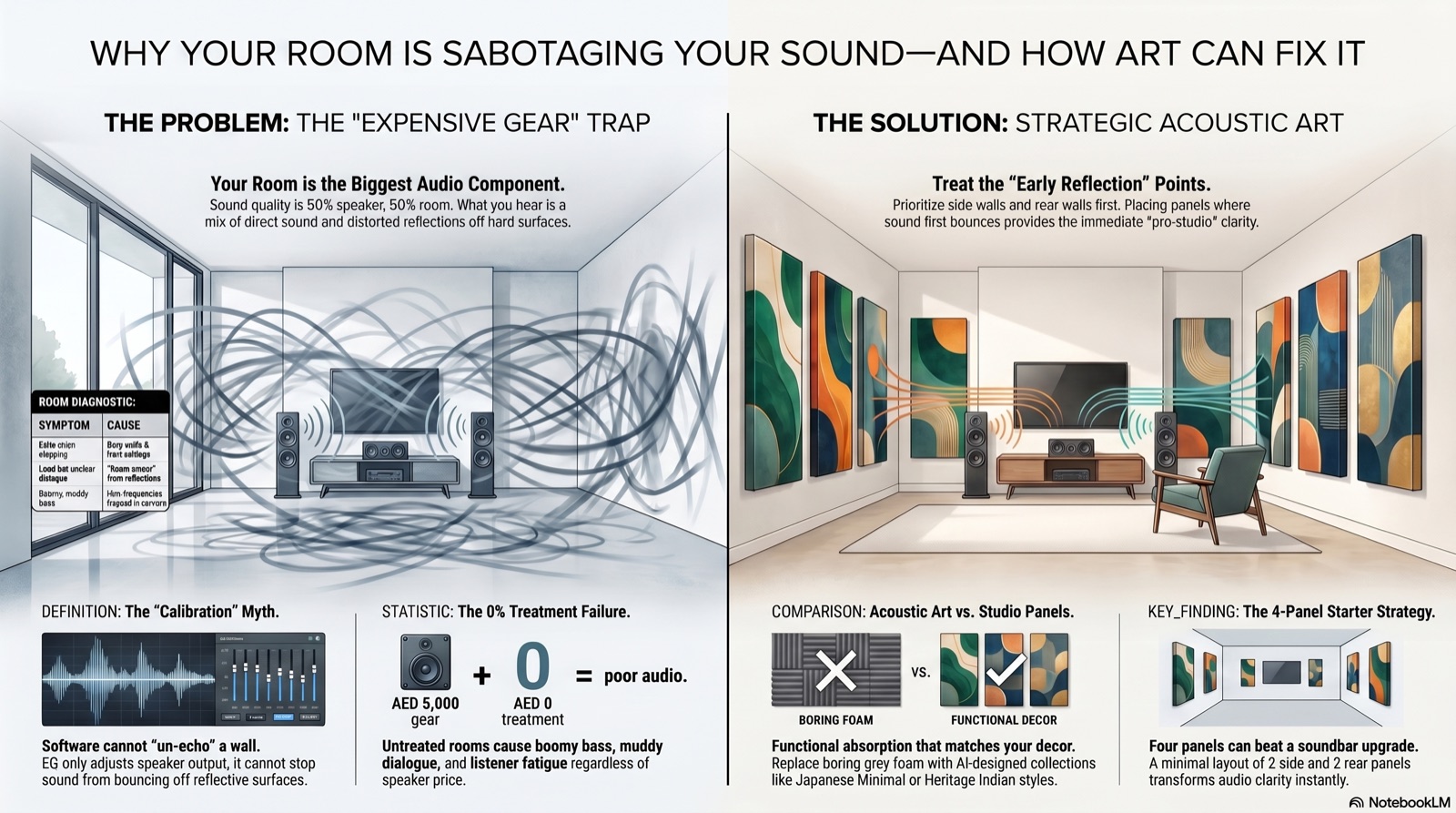
The speaker produces the sound. The room decides what reaches your ears. Spend AED 5,000 on gear and AED 0 on the room, and you are simply hearing a beautifully amplified room problem.
Walk into any electronics showroom and the promises are everywhere: “cinema sound at home”, “deep bass”, “immersive surround”, “AI room calibration”. So people invest in soundbars, subwoofers, AV receivers and high-resolution audio — then place all of it inside a room with bare walls, hard ceilings, tiled floors, glass windows and empty corners. And not a single acoustic absorption panel.
That is like buying a premium instrument and playing it in a stairwell. The instrument is excellent — but the space is sabotaging it.
Your room is the biggest “audio component” you own.
You are hearing reflected sound, not the real sound
People assume sound quality comes from the speaker. The physics is simpler than that. Everything you hear is a mix of two things: the direct sound that travels straight from the speaker to your ears, and the reflected sound that bounces off the walls, ceiling, glass and floor and arrives a fraction of a second later.
In a typical untreated living room, well over half of what reaches your ears is reflection rather than direct sound. Those late, smeared copies of the music are not harmless. They create:
- Echo and reverb — the “hall” sound that lingers after every note
- Flutter echo — that sharp, pingy repetition between two parallel hard walls
- Smearing — voices and lyrics lose their edges and clarity disappears
- Boomy bass — low frequencies pile up in corners and along walls
- Dead spots — bass cancels out, so it sounds powerful in one seat and weak in another
So even with an expensive soundbar, your ears catch a distorted version of what the speaker actually produced — because the room keeps throwing false reflections back at you.
Why “room calibration” can’t fully fix it
Brands talk about “room tuning”, “Trueplay”, “auto EQ”, calibration mics and “smart correction”. These systems measure the room and adjust the speaker’s output, which genuinely helps. But there is a hard physical limit:
EQ cannot stop sound from bouncing.
Calibration only changes what the speaker sends out. The surfaces are still reflective, so the reflections still happen. Think of it this way: calibration is like adjusting the seasoning in a dish, while acoustic treatment is like upgrading the ingredients and the cookware. If the room is echoing, no software can “un-echo” your walls — the sound still hits the wall, still reflects, still returns late. That is why a system can measure as “tuned” and still feel harsh, fatiguing or unclear: the room itself is untreated.
The trap: turning up the volume just turns up the room
Most listeners react to a muddy room by reaching for the volume — chasing clarity. But louder direct sound also means louder reflections. The room gets messier, more fatiguing, and harder to listen to. It is exactly why so many homes report the same three complaints:
- “Music is exciting for two minutes… then it becomes tiring.”
- “Dialogue is loud, but still not clear.”
- “Bass is powerful, but not clean.”
None of this means your speaker is bad. It means the room is acting as a distortion layer between the speaker and your ears.
What actually improves sound: treat the early reflections
You don’t need to turn your home into a recording studio. You need strategic absorption. The single highest-impact move is to treat the early reflection points — the first surfaces sound bounces off after leaving the speaker. In rough order of priority:
- Side walls beside your seat (the first reflection points)
- The rear wall behind your seating
- The ceiling above the listening area
- Corners (where bass energy builds up)
Even four to six well-placed acoustic absorption panels can make a bigger difference than upgrading from a mid-range soundbar to a premium one. (A quick test of how a panel performs is its NRC — Noise Reduction Coefficient; the higher the figure, the more sound energy it absorbs rather than reflects.)
A simple starter-treatment plan most homes can handle
If you already own a decent soundbar, subwoofer or basic home theatre:
- Minimum (high impact): 2 panels on the side walls at first-reflection points + 2 panels on the rear wall behind your seat.
- Better: add 1–2 panels on the ceiling or high rear wall.
- Only if needed: add corner bass control once the walls and ceiling are handled.
The result is immediate: clearer speech, less “roomy” sound, less harshness and more controlled bass. The honest staged path is reflections → ceiling → corners — not bass traps first.
The apartment hallway problem (a very real UAE case)
In duplex apartments and modern flats, hallways become echo tunnels: long, narrow passages with hard floors, hard walls, minimal furniture and bare ceilings. The home ends up sounding louder than it is — footsteps are sharp, voices bounce, and the whole space feels harsh. Most people never solve it because traditional panels look dull, don’t match the interior, and feel “studio-like”. Yet the hallway is exactly where decorative acoustic art earns its place: it looks like premium wall art, it cuts the reverb, and it makes the entire home feel calmer and higher-end. This isn’t only an audio fix — it’s a comfort and lifestyle upgrade.
Who needs this more than they realise
- Home-theatre & soundbar owners — dialogue gets clearer, bass tighter.
- Music students & practice rooms — you hear real detail instead of room smear, so practice is more accurate.
- Dance schools — cleaner playback, less harshness, less fatigue across long sessions.
- Classrooms & activity rooms — better speech intelligibility means better focus, and teachers strain their voices less.
- Kids’ rooms — toys, TV and play make them loud; panels soften the harshness with fun themes.
- Restaurants & cafés — the #1 complaint in beautiful venues is “too noisy to talk”; absorption plus décor fixes it without ruining the design.
Why people avoid acoustic panels — and why that has to change
Let’s be blunt: most acoustic panels look boring. Grey fabric rectangles. Office vibes. Studio vibes. So people put up with echo rather than hang them. That is the exact gap Kairali set out to close — because if absorption looked like art, people would actually use it. Not because they’re audio geeks, but because it improves the space both visually and acoustically.
Buy it because it’s beautiful. Keep it because it makes sound better.
At Kairali we live inside music, rhythm, movement and Indian visual culture, so we know sound is never just equipment — it’s space, feeling and clarity. Our panels carry a high-density absorptive core behind a breathable fabric face printed (or hand-painted) with Indian art and contemporary designs. They reduce echo, reverb and flutter echo so a room sounds clearer, while reading as gallery art on the wall. One honest note: this is acoustic absorption — reducing echo and reverb inside the room — not full soundproofing, which means stopping noise passing between rooms.
Quick self-check: does your room need absorption?
If you answer “yes” to any of these, your next upgrade isn’t another speaker — it’s your room:
- Do you hear an echo when you clap in the room?
- Do voices sound loud but unclear?
- Does bass boom in one spot and vanish in another?
- Do you have tiles + glass + bare walls?
- Does your hallway sound like a tunnel?
- Does your expensive soundbar still feel underwhelming?
A small investment in acoustic absorption can make a mid-range system sound premium — and finally make a premium system feel worth the price. And when absorption is designed as art, people stop avoiding it. They adopt it.
Kairali Acoustics
The Acoustic Art Panel Board
Decorative acoustic absorption that looks like gallery art — Portrait, Large Square, Triptych and Four-Panel Cultural editions, printed or hand-painted with Indian heritage and contemporary designs. Born inside our own teaching studios in Sharjah.
Rate this insight
Was this useful?
Share this article